Part 1 of 6 · AI readiness and execution for providers across aged care and disability
Introduction
Why AI literacy is now a leadership skill
Not long ago, AI in a care organisation meant a pilot or a vendor demonstration. Today it arrives inside the rostering software, the note-taking tool and the phone in every worker’s pocket, often before anyone has decided it should. The national AI Adoption in Aged Care Workgroup observes that AI is already present in most aged care organisations, often informally and without clear direction.2 Leaders now face a harder question than whether to use AI: which kinds are we already using, what does each one need from us, and who is accountable when it is wrong?
This article offers a framework for answering those questions. It sets out the five kinds of AI a provider will meet, the four types of content they work on, how each behaves under real conditions, how to match each to the job, and the rules that apply whichever one you choose.
About this article. Written for boards, executives and quality and governance leads in aged care and NDIS. It draws on a global survey of public attitudes to AI, national guidance, sector guidelines, peer-reviewed research and regulator publications, listed at the end. The ratings in Charts 2 and 3 are Amalthēa Health’s own indicative framework, not measured data.
Section 1 · The literacy gap
AI is already in the building. The literacy is not yet.
A roster checker, a falls-risk score and a note-writing assistant will all be sold to a care provider as “AI”. They share a label and very little else. One follows rules a person wrote. One learned patterns from past records. One was trained on a large slice of the internet and can write in any register you ask for. Each needs different evidence before purchase and different supervision after it.
Australia starts from a low base. In the largest global survey of public attitudes to AI, only 24 per cent of Australians reported any AI training or education, against 39 per cent worldwide. About half use AI regularly anyway.1
Source: Gillespie et al., The University of Melbourne and KPMG, Trust, attitudes and use of AI: a global study 2025.1
Four questions that define AI literacy
AI literacy, for a board or an executive team, does not mean learning to code. It means being able to ask four questions of any system, and to recognise a good answer when it comes.
| Question | Why it matters | A good answer sounds like | A warning sign |
|---|---|---|---|
| What kind of AI is this? | The kind sets how it behaves and how it fails | “A machine-learning model that scores falls risk” | “It’s just AI” |
| What did it learn from? | Gaps in the data become blind spots | “De-identified records from services like ours” | The vendor cannot say |
| How does it fail? | It tells you what to watch for | “It can be wrong where residents differ from its training population” | “It doesn’t” |
| Who checks its work? | Accountability stays with people | “A named role approves every output” | “The system decides” |
Swipe sideways to see every column.
The National AI Centre’s Guidance for AI Adoption opens with accountability as the first of six practices.4
The implicationLiteracy comes before procurement, because a buyer who cannot name the kind of AI cannot judge the evidence for it.
Section 2 · Five kinds of AI
Four generations, and a way of using the newest
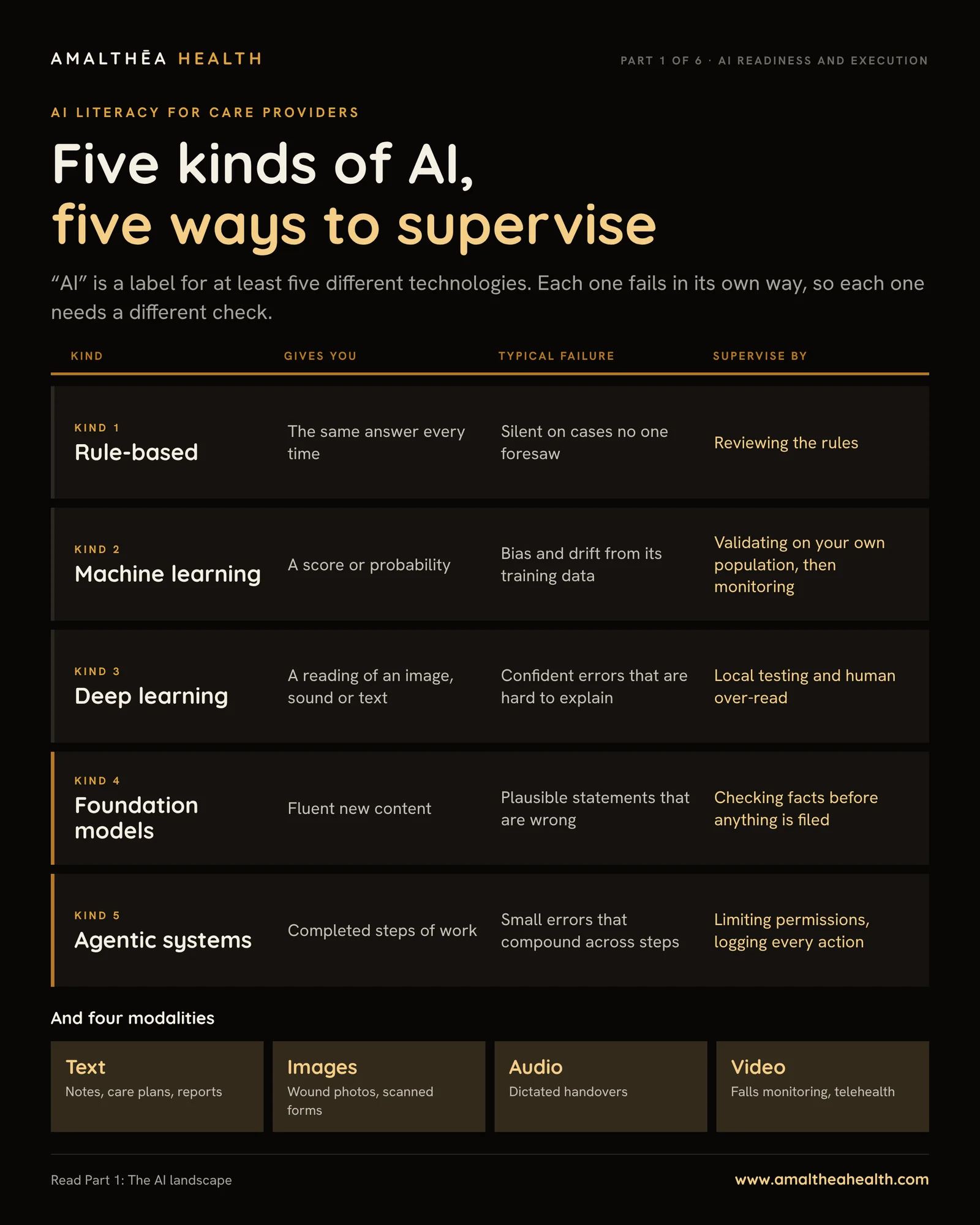
The label “AI” covers a family of techniques that arrived in sequence. Each generation added capability and changed the way it fails.
| Kind | How it works | Best at | Care example | First thing to ask |
|---|---|---|---|---|
| Rule-based | Follows rules a person wrote | Certainty and audit | Medication interaction alert | Who owns the rules? |
| Machine learning | Infers patterns from historical data and returns a probability | Prediction | Falls-risk score | Was it validated on people like ours? |
| Deep learning | Many-layered neural networks working on raw images, sound and text | Perception | Wound image assessment | How was it tested locally? |
| Foundation models | Trained once on very broad data, then adapted to many tasks | Flexible language work | Drafting progress notes | Does a person read it before it is filed? |
| Agentic systems | A foundation model given a goal, tools and permission to act | Multi-step work | Assembling a referral pack for sign-off | What may it do without asking? |
Swipe sideways to see every column.
Rule-based systems do exactly what a person wrote down. If a resident is prescribed two medicines that interact, raise an alert. If an incident is Priority 1, start the 24-hour reporting clock. The logic can be read, tested and audited line by line.
Machine learning turns that around. Nobody writes the rules; the system infers them from historical data. Falls-risk scores, deterioration warnings and demand forecasts work this way, and the quality of the answer depends on the quality of the history.
Deep learning is machine learning built from many-layered neural networks. Its gift is perception: it works directly on raw images, sound and free text, where earlier methods needed a person to prepare the data first.
Foundation models are the newest generation. Stanford researchers coined the term in 2021 for models trained once on very broad data and then adapted to many tasks.7 The large language models behind today’s chat assistants are foundation models. The same model can draft a care plan, summarise a week of progress notes and translate a family letter, without being built for any of them.
Agentic systems are a way of using foundation models, more than a fifth generation. Give a model a goal, access to tools and permission to act, and it will plan the steps, carry them out and check the result, asking a person when judgement is needed.8
Terms worth knowing
- Model
- · the trained piece of software that turns an input into an output.
- Training data
- · the examples a model learned from. Its gaps become the model’s blind spots.
- Generative AI
- · AI that produces new text, images, audio or video, usually from a foundation model.
- LLM
- · large language model, a foundation model trained mainly on text.
- Multimodal
- · able to take in or produce more than one kind of content.
- Drift
- · the gradual loss of accuracy as the real world moves away from the training data.
The implicationThe five kinds are not rungs on a ladder to be climbed. They are tools with different jobs, and the oldest is often still the right one.
Section 3 · Modalities and privacy
Four modalities, four sets of privacy stakes
A modality is the kind of content a system reads or produces. Four cover almost everything a provider will meet. Foundation models are increasingly multimodal: one system can listen to a handover, read the care plan and write the note. Modality matters to governance because it sets the privacy stakes.
| Modality | What it covers in care | Privacy stakes | A question for your AI policy |
|---|---|---|---|
| Text | Progress notes, care plans, policies, incident reports, emails | Lower to moderate | Where does personal information go when it is typed into a tool? |
| Images | Wound photographs, scanned forms, x-rays | Moderate to high | Who can view and store the images, and for how long? |
| Audio | A handover dictated into a phone, a care conversation turned into notes | High | Was everyone on the recording told, and who keeps it? |
| Video | Camera-based falls monitoring, telehealth sessions | Highest | Is continuous monitoring proportionate, and who agreed to it? |
Swipe sideways to see every column.
Amalthēa Health framework. Indicative ratings, not measured data.
A typed summary and a continuous video feed from a resident’s room are very different propositions under the same AI policy.
The implicationOne AI policy for all content is too blunt. Set the rules by modality, and tighten them as the content gets richer.
Section 4 · Capability and predictability
The more capable the AI, the less predictable it is
Two patterns are worth holding on to, and the infographic below sets them out. Moving from the oldest kind to the newest, systems become more capable and less predictable: a rule gives the same answer every time, while a foundation model may give a different answer to the same question asked twice. Along the same path, supervision shifts from checking the logic to checking the output.
On a phone, swipe sideways to read the full chart.
Scale 1 (lowest) to 5 (highest). Amalthēa Health framework. Indicative ratings, not measured data.
What supervision looks like for each kind
| Supervision activity | Rule-based | Machine learning | Deep learning | Foundation models | Agentic systems |
|---|---|---|---|---|---|
| Review the logic line by line | Core | Light | None | None | None |
| Validate on your own population | Light | Core | Core | Some | Some |
| Monitor for drift after go-live | Light | Core | Core | Some | Some |
| Check every output before it is relied on | None | Some | Core | Core | Core |
| Limit permissions and log every action | None | None | None | Some | Core |
Swipe sideways to see every column.
Indicative guidance. Actual supervision depends on the use case and its risk.
Machine learning carries a further wrinkle: a model validated at purchase can lose accuracy quietly as residents, staff and practices change.9
The implicationSupervision is not one activity. Buy the checks that belong to the kind of AI, and budget for them.
Infographic · Sections 2 to 4 on one page
Section 5 · Matching technology to process
Match the job to the family member
The practical use of all this is in procurement and governance. A reporting deadline needs certainty, so it belongs to rules. Anticipating which residents are likely to deteriorate is a prediction, so it belongs to machine learning, with local validation. Drafting is language work and suits a foundation model, with a person reading before anything enters the record.
| The job | Right family | Why | The human check | The wrong fit looks like |
|---|---|---|---|---|
| 24-hour incident reporting clock | Rule-based | It needs the same answer every time | The rule owner reviews when requirements change | A generative model “estimating” the deadline |
| Medication interaction alert | Rule-based | The logic is clear and auditable | A clinician reviews every alert | An opaque score with no reasons |
| Which residents may deteriorate | Machine learning | It is a prediction from past patterns | Validate locally, then monitor for drift | A purchased model never tested on your residents |
| Reading a wound photo or scanned form | Deep learning | It is a task of perception | Local testing, with a clinician over-reading | Treating the output as a diagnosis |
| Drafting a progress note or care plan summary | Foundation model | It is flexible language work | A person reads and corrects it before it is filed | Filing the draft unread |
| Assembling a referral pack from several systems | Agentic system | It is multi-step work across tools | Limited permissions and sign-off before it goes anywhere | An agent that can send or lodge on its own |
Swipe sideways to see every column.
A vendor who offers a generative model for a job that needs the same answer every time has chosen the wrong family member.
The implicationThe right question for a vendor is not “does it use AI?” but “which kind, for which job, checked by whom?”
Section 6 · The rules do not change with the tool
Obligations follow the provider, not the technology
The regulatory setting rewards that discipline, and the main pieces arrived within a few months of each other.
- Guidance for AI AdoptionNational AI Centre4
- Aged Care Act 2024 and strengthened Quality Standards commenceDepartment of Health, Disability and Ageing10
- National AI Plan releasedDepartment of Industry, Science and Resources12
- Guidance on AI and medical device softwareTherapeutic Goods Administration11
| Instrument | What it does | What it means for a provider |
|---|---|---|
| Aged Care Act 2024 and Quality Standards | Applied from 1 November 202510 | Your obligations do not change with the tool you use |
| TGA guidance on AI and medical device software | Draws its line by intended purpose11 | Software that shapes diagnosis or treatment is a medical device, whatever technique sits underneath |
| National AI Plan | Leans on existing laws and regulators12 | Accountability stays with the organisation that deploys the system |
| Guidance for AI Adoption | Sets out six practices, with accountability first4 | A ready structure for your own AI policy |
| Generative AI guidelines for aged care | Adopted by more than 100 providers3 | A sector-specific starting point |
Swipe sideways to see every column.
The implicationThere is no regulatory shelter in the technology. Whoever deploys the system answers for it.
Section 7 · Conclusion
Literacy is the first control
The organisations that get the most from AI in the next few years will not be the ones that bought the most of it. They will be the ones that knew what they were buying.
That starts with a plain discipline. Name the kind of AI in front of you. Ask what it learned from. Expect the failure that belongs to its family. Put a person’s name against every output. A rule needs its owner. A prediction needs local proof. A draft needs a reader. An agent needs a boundary. None of it is technical, and all of it is leadership.
The stakes are not abstract. Residents and participants live with what these systems get right and what they get wrong, and because existing laws and regulators still apply, accountability stays with the organisation that deploys them. Providers who build this literacy now will adopt faster and with less regret, because they will know which door each tool belongs behind.
Five moves for the next 90 days
Take stock
List every AI tool in use, official or not, including those staff use informally.
Classify
Tag each one with its kind and the type of content it handles.
Ask the four questions
Put them to every tool and record the answers.
Name an owner
One accountable person for each tool’s outputs.
Set the supervision
Match the checks to the kind, using Table 4.
Models will keep changing. The questions will not. An organisation that can ask them of any system is ready for the next one, whatever it is called.
Amalthēa Health
Where Amalthēa Health comes in
Most providers will meet all five kinds of AI within the same year, from different vendors, with different risks. Amalthēa Health offers two AI-native products for aged care and disability providers. Both were built around AI from the first day, for Australian care, with your people in charge.
Phoebe does the day-to-day administrative work of running care services. A team of digital staff, each with one job such as intake, rostering or finance, prepares the routine work. Your staff review it, approve it and make the decisions.
Delphi shows how the organisation is performing and whether it is ready for audit. Leaders ask a question in plain English and see the answer with its source.
What a provider can expect:
- Administrative time back: less preparing, checking and chasing paperwork, and more time for decisions and care.
- Claims that are right the first time: every service line is checked before a claim is prepared.
- Deadlines met: reporting times, reviews and expiring plans are tracked and raised early.
- Ready for audit all year: evidence is kept against each standard as the work happens.
- A clear view for leaders and boards: answers arrive without waiting for a report to be built by hand.
Both products cover NDIS, Support at Home, the Commonwealth Home Support Programme and residential aged care, and work with the systems you already use. Your information stays in Australia, is kept separate from every other provider’s and remains yours. Every step is recorded. Phoebe never makes a clinical decision, and a person in your organisation lodges anything that goes to government or a regulator. Certification to ISO/IEC 27001 and ISO/IEC 42001 is in progress.
Is your organisation working out which AI it already has, and which it actually needs? See how Phoebe and Delphi fit your programs.
Email info@amaltheahealth.com and visit us at www.amaltheahealth.com.
References
- Gillespie N, Lockey S, Ward T, Macdade A, Hassed G. Trust, attitudes and use of artificial intelligence: a global study 2025. The University of Melbourne and KPMG; 2025. doi:10.26188/28822919.
- Ageing Australia, with the national AI Adoption in Aged Care Workgroup. Adopting AI in your aged care organisation: a practical walkthrough (event overview). 2026.
- AI Adoption in Aged Care Workgroup. Guidelines for the Responsible Use of Generative AI in Aged Care (updated edition). 2026.
- National Artificial Intelligence Centre. Guidance for AI Adoption. Canberra: Department of Industry, Science and Resources; October 2025.
- Obermeyer Z, Powers B, Vogeli C, Mullainathan S. Dissecting racial bias in an algorithm used to manage the health of populations. Science. 2019;366(6464):447–453.
- Seah JCY, et al. Effect of a comprehensive deep-learning model on the accuracy of chest x-ray interpretation by radiologists: a retrospective, multireader multicase study. Lancet Digital Health. 2021;3:e496–e506.
- Bommasani R, Hudson DA, Adeli E, et al. On the opportunities and risks of foundation models. Stanford Center for Research on Foundation Models; 2021. arXiv:2108.07258.
- Collaco BG, Haider SA, Prabha S, et al. The role of agentic artificial intelligence in healthcare: a scoping review. npj Digital Medicine. 2026;9:345.
- Finlayson SG, Subbaswamy A, Singh K, et al. The clinician and dataset shift in artificial intelligence. New England Journal of Medicine. 2021;385(3):283–286.
- Department of Health, Disability and Ageing. Aged Care Act 2024 and strengthened Aged Care Quality Standards, commenced 1 November 2025.
- Therapeutic Goods Administration. Artificial intelligence (AI) and medical device software regulation: guidance. Canberra: TGA; February 2026.
- Department of Industry, Science and Resources. National AI Plan. Canberra: Australian Government; December 2025.